Common SWOT Analysis Mistakes: The Danger of the Static List


On this page
- Mistake 1: Confusing Aspirations with Strengths
- Mistake 2: The 'Laundry List' Syndrome (Failing to Prioritize)
- Mistake 3: Blurring the Internal and External Lines
- Mistake 4: Evaluating Strengths in a Vacuum
- Mistake 5: The Executive Echo Chamber (Cognitive Bias)
- Mistake 6: Stopping at the List (Failing to Synthesize)
- Summary: Demand Rigor and Conflict
Download SWOT Analysis Templates
Download 100% free offline templates in your preferred format.
The SWOT analysis is simultaneously the most famous and most frequently misused strategic framework in business. Its elegant simplicity—a basic four-quadrant grid—is ironically its biggest trap. Because the barrier to entry is so low, teams assume the strategic thinking required to complete it is equally effortless.
As a result, most SWOT sessions devolve into unstructured, opinion-based brainstorming that produces a static list of corporate platitudes. When a SWOT analysis fails to drive meaningful action or change resource allocation, it is almost always because the team fell into one of these fundamental structural or cognitive traps.
Mistake 1: Confusing Aspirations with Strengths
The most pervasive mistake in a SWOT analysis occurs in the top-left quadrant. Teams frequently list things they want to be true—or things they value internally—as established market strengths. They write down "innovative culture," "passionate team," "commitment to excellence," or "hardworking founders."
These are not strategic strengths; they are table stakes. A true strength is a demonstrable, defensible advantage that separates you from your competitors in a way the customer actually cares about.
If your listed strength is a generic claim that your competitor could also write on their whiteboard without laughing, it does not belong on the canvas. A real strength is a proprietary data asset, exclusive distribution rights, a structural cost advantage (e.g., you own your manufacturing facility while competitors rent), or an overwhelmingly dominant Net Promoter Score. It must be empirically true today, backed by data, not an aspiration for tomorrow.
Mistake 2: The 'Laundry List' Syndrome (Failing to Prioritize)
A common outcome of a highly collaborative SWOT workshop is a grid stuffed with 15 to 20 bullet points in every quadrant. Teams feel productive because they generated a massive amount of data, but a massive list is strategically paralyzing.
Not all threats are existential, and not all weaknesses are fatal. A minor UI bug on an internal tool (a weakness) should not carry the same strategic weight as the fact that your primary supplier is facing bankruptcy (a threat). When a SWOT analysis is not ruthlessly prioritized, it provides no direction on where leadership should focus their limited time and capital.
The Fix: Force the team to rank the points. Use a simple 'Probability x Impact' score for threats and opportunities, and demand that only the top 3 to 5 most critical items survive to the final version of the matrix.
Mistake 3: Blurring the Internal and External Lines
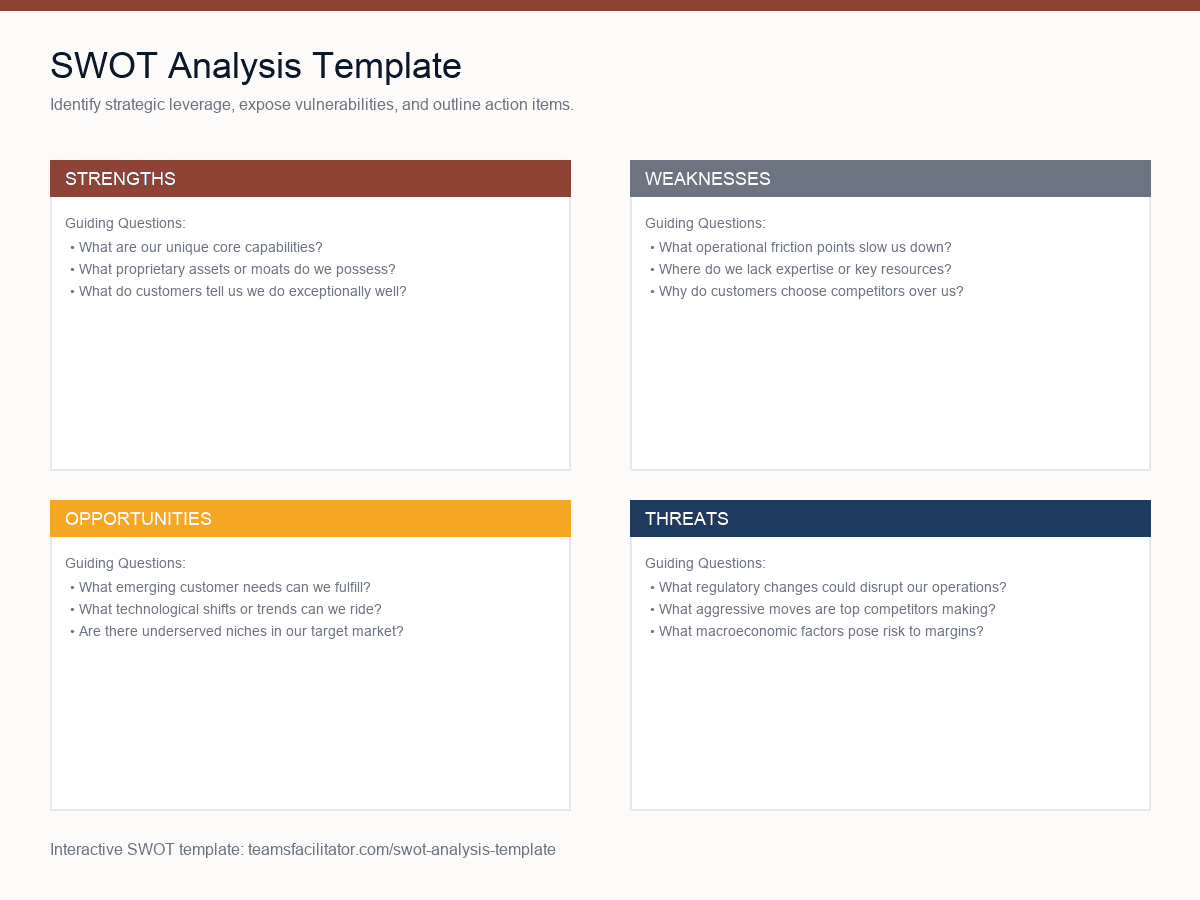
The fundamental logic of SWOT relies on the strict separation between what you control (Internal: Strengths/Weaknesses) and what you must navigate (External: Opportunities/Threats). When teams blur this line, the matrix breaks down into a disorganized to-do list.
A classic example is listing "Launching a new mobile app" as an Opportunity. Launching an app is an internal project; you control whether you do it or not. It is an action. The actual Opportunity is "the sudden demographic shift toward mobile-first commerce in our target market." The app is simply your proposed response to that external reality.
If you put internal tasks and projects in the external boxes, you are skipping the analysis phase and jumping straight to unvalidated solutions.
Mistake 4: Evaluating Strengths in a Vacuum
Strengths and weaknesses are relative, not absolute. A common failure mode is evaluating internal capabilities without directly comparing them to the competition.
For instance, your team might list "Strong Logistics Network" as a strength because you recently improved your delivery times from 5 days to 3 days. Internally, that feels like a massive win. However, if your primary competitor offers guaranteed next-day delivery, your "strength" is actually a critical weakness in the context of the broader market. A SWOT analysis requires looking at your company from the outside in, judging your capabilities against the established baseline of your industry, not against your past performance.
Mistake 5: The Executive Echo Chamber (Cognitive Bias)
A SWOT analysis conducted entirely by a homogenous group of senior executives is highly susceptible to groupthink, confirmation bias, and the halo effect. Executives are often insulated from the daily operational friction of the business and tend to view the company through an overly optimistic lens.
If you want an honest assessment of your Weaknesses and Threats, you must involve the people closest to the customer and the code. Customer success representatives know exactly why clients are churning; they hear the complaints daily. Engineers know exactly where the technical debt is catastrophic. Conducting a SWOT without cross-functional, frontline input almost always results in a sanitized, defensive document that ignores the real, systemic vulnerabilities of the organization.
Mistake 6: Stopping at the List (Failing to Synthesize)
This is the fatal error that renders the entire exercise a complete waste of time. A team spends three hours debating the four boxes, nods in agreement at the beautifully formatted grid, types it up into a slide deck, and moves on to the next agenda item.
A completed SWOT grid is not a strategy; it is a raw data set. It is a diagnostic readout. To generate strategic value, you must synthesize the quadrants. You have to ask the hard, cross-sectional questions (often using a TOWS matrix):
- How will we use Strength A to exploit Opportunity B?
- How does Threat C exploit Weakness D, and what is our immediate mitigation plan?
Strategy is the art of making consequential choices on how to deploy limited resources. If the SWOT analysis does not conclude with a prioritized list of concrete actions—investments, divestments, or structural process changes—it was merely an illusion of strategic planning.
Summary: Demand Rigor and Conflict
A proper SWOT analysis should not be a comfortable, agreeable meeting. It is a diagnostic tool designed to expose organizational vulnerability and highlight strategic leverage. By demanding rigorous, data-backed definitions of strengths, ruthlessly prioritizing the list, separating internal actions from external realities, and forcing a final, actionable synthesis step, you can rescue the SWOT framework from the realm of corporate busywork and transform it into a powerful engine for competitive clarity.
Ready to put this into practice? Run a guided session with your team using our interactive SWOT Analysis Template.
Quick Facts

SWOT Analysis Template
Assess strengths, weaknesses, opportunities, and threats to align strategy.

Personal SWOT Template
Conducting a SWOT analysis on yourself is an excellent way to map out professional goals and prepare for career moves. T...

How to Conduct a SWOT Analysis That Actually Drives Strategy
Most organizations conduct a SWOT analysis as a superficial compliance exercise. They gather a leadership team in a room...