What is a SWOT analysis?
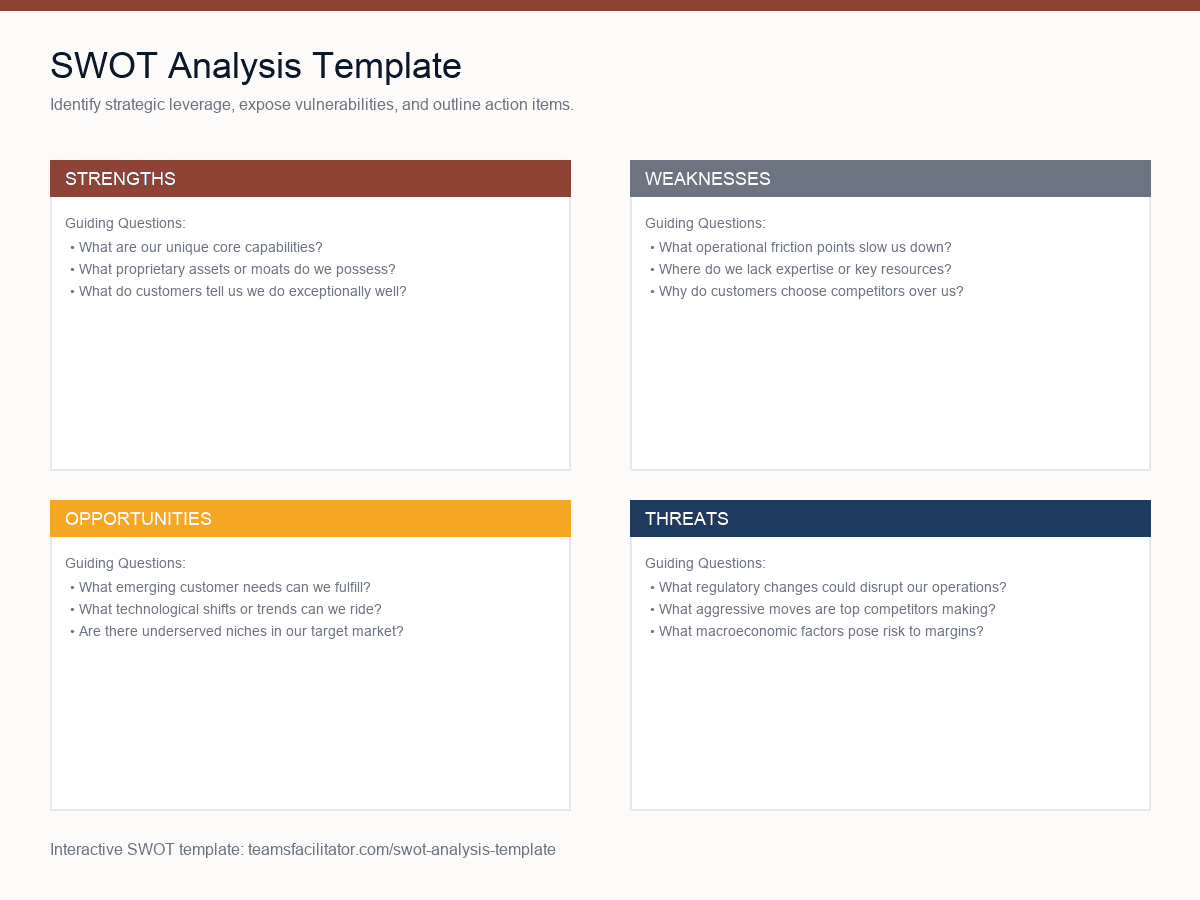
A SWOT Analysis is a forcing function that synthesizes internal capabilities and external realities to drive consequential resource allocation. It is a diagnostic tool to expose vulnerability and strategic leverage.
- Best for
- Strategic Planning & Positioning
- Time
- 45–60 mins
- Who joins
- 3–8 team members
- You leave with
- A prioritized list of strategic initiatives and risks.
When to use a SWOT analysis
Use it during annual strategic planning, before launching a major product line, entering a new market, or as an intervention when unexpectedly losing market share to competitors.
How to run a SWOT analysis
Start by applying the VRIO framework (Value, Rarity, Imitability, Organization) to identify true internal Strengths and Weaknesses. Then, use PESTLE to map external Opportunities and Threats. Score all items by Probability and Impact to force prioritization.
Questions to ask in each section
01Strengths
- Does this capability pass the VRIO test (Value, Rarity, Imitability, Organization)?
- Do we have empirical metrics to prove this is a true competitive moat?
- Are these actual strengths or just baseline industry expectations?
02Weaknesses
- What specific operational flaw would be the primary cause if the company failed this year?
- Where are we structurally disadvantaged compared to our top competitor?
- Exactly how much revenue is this weakness costing us?
03Opportunities
- What systemic PESTLE forces (Political, Economic, Sociocultural, Technological, Legal, Environmental) can we exploit?
- How can we leverage our core strengths to aggressively capture market share?
04Threats
- What external forces could instantly compress margins or disrupt our supply chain?
- Are there emerging tech disruptions or regulatory changes threatening our distribution?
- What obstacles could severely cripple our operational model?
Worked examples
Startup Launch SWOT
A SaaS startup targeting small businesses doing a SWOT before a major launch.
- Nimble and fast engineering team
- Modern tech stack with lower maintenance costs
- Highly specialized niche product
- Small marketing budget
- Low brand recognition
- Limited customer support coverage
- Competitors are raising prices
- New AI trends align with our product roadmap
- Partnership opportunity with a complementary software tool
- Larger competitor copying features
- Economic downturn reducing SMB spend
- Changes in third-party API terms
Common mistakes
- Confusing aspirations and corporate platitudes with empirical, defensible strengths.
- The 'Laundry List' syndrome: generating massive lists without prioritizing by probability and impact.
- Blurring internal actions (e.g., 'building an app') with external realities.
- The Executive Echo Chamber: conducting the analysis without frontline, cross-functional input.
Let Medi run your SWOT analysis
Most SWOTs produce a static list of corporate platitudes. Methodiq asks for evidence behind every claim, brings uncomfortable realities into the open, and connects findings across the four quadrants to prevent groupthink.
- One shared canvasEveryone adds notes at the same time, in the room or remote.
- A facilitator in the roomMedi keeps each section moving and draws in the quiet voices.
- A written outcomeDecisions, owners and next steps, captured before anyone leaves.
SWOT analysis FAQ
What is SWOT used for?
SWOT is used to evaluate a company's competitive position and to develop strategic planning. It assesses internal and external factors, as well as current and future potential.
What is the difference between SWOT and PESTLE?
SWOT focuses on both internal (Strengths/Weaknesses) and external (Opportunities/Threats) factors. PESTLE focuses entirely on macro-environmental external factors (Political, Economic, Social, Technological, Legal, Environmental).
How long should a SWOT analysis take?
A quick, solo SWOT can take 30 minutes, but a comprehensive team session should take 1 to 2 hours to allow for healthy debate and alignment.
Can one person do a SWOT?
Yes, individuals can do personal SWOTs for career planning or quickly outline a project. However, business SWOTs are much more effective when done as a group to eliminate blind spots.
Should SWOT be done before a business plan?
Yes, typically a SWOT is done early in the strategic planning process to inform the goals and initiatives that go into the business plan.
Is SWOT still relevant?
Absolutely. While it's an older framework, its simplicity is its superpower. It forces teams to categorize complex information into actionable areas.
What's the difference between strengths and opportunities?
Strengths are internal factors you currently control (e.g., a great team, patents). Opportunities are external factors outside your control that you can take advantage of (e.g., a new market trend, a competitor going bankrupt).
More SWOT analysis guides
- Common SWOT Analysis Mistakes: The Danger of the Static List
- How to Conduct a SWOT Analysis That Actually Drives Strategy
- What is a SWOT Analysis?
- SWOT Analysis Examples: 6 Realistic Business Scenarios
- SWOT vs. TOWS: What's the Difference?
- The TOWS Matrix: How to Turn Your SWOT Analysis Into a Strategy
- How to Lead a Strategic SWOT Analysis
- 60 SWOT Analysis Questions That Produce Better Answers
- What to Do After a SWOT Analysis: Turn the Matrix Into Action