How to Conduct a SWOT Analysis That Actually Drives Strategy


On this page
- Step 1: Establish a Razor-Sharp Strategic Context
- Step 2: The Pre-Work (Banning Subjectivity)
- Step 3: The External Audit (Using PESTLE)
- Step 4: Prioritizing and Scoring the Matrix
- Step 5: The Strategic Synthesis (The TOWS Matrix)
- Step 6: From Synthesis to Execution (OKRs)
- Summary: A Forcing Function for Choice
Download SWOT Analysis Templates
Download 100% free offline templates in your preferred format.
Most organizations conduct a SWOT analysis as a superficial compliance exercise. They gather a leadership team in a room, draw a 2x2 grid on a whiteboard, brainstorm a list of subjective bullet points, and then immediately file the resulting document away in a strategy deck that no one reads again. This process produces a list of feelings, not a strategy.
The true goal of a SWOT analysis is not to categorize your business; the goal is to create a dynamic synthesis of internal capabilities and external realities that forces the organization to make hard, consequential choices about resource allocation. To achieve this, you must move beyond the whiteboard and introduce rigorous data, supporting frameworks, and a structured synthesis process.
Here is the advanced, step-by-step guide to conducting a SWOT analysis that actually drives your strategy forward.
Step 1: Establish a Razor-Sharp Strategic Context
A SWOT analysis conducted in a vacuum—or one that simply evaluates "the overall business"—is guaranteed to be useless. The scope is too broad, leading to generic observations. Before anyone writes a single post-it note, you must define the precise strategic objective.
Are you evaluating a specific new product launch? A potential acquisition target? A geographic expansion? A response to a specific competitor's new pricing model?
- Weak Context: "Let's do a SWOT on our company."
- Strong Context: "Let's do a SWOT on our strategy to enter the mid-market enterprise SaaS segment within the next 18 months, focusing on our current product suite."
A sharp, actionable context acts as a filter, immediately disqualifying irrelevant data and keeping the team focused on the specific battlefield at hand.
Step 2: The Pre-Work (Banning Subjectivity)
The biggest enemy of a good SWOT is the "gut feeling." To combat executive optimism and cognitive bias, you must demand that all assertions be backed by hard data before the workshop even begins.
If someone claims "Customer Service" is a strength, they must bring the Net Promoter Score (NPS), resolution times, and churn rates to prove it. If they claim a "Strong Brand," they need brand awareness metrics or search volume data.
Best Practice: The VRIO Framework for Strengths When evaluating internal Strengths and Weaknesses, use the VRIO framework to test if something is a genuine strategic advantage:
- Value: Does this capability allow you to exploit an opportunity or neutralize a threat?
- Rarity: How many competitors also possess this capability?
- Imitability: How hard or expensive would it be for a competitor to copy it?
- Organization: Is your company structured to actually capture the value from this capability?
If a capability passes all four tests, it is a true core strength. If it doesn't, it is merely table stakes—or worse, a weakness in disguise.
Step 3: The External Audit (Using PESTLE)
The bottom half of the matrix looks outward at Opportunities and Threats. These are external macro-environmental forces that you cannot control, but must navigate. A common mistake is to only look at immediate, direct competitors.
To ensure a comprehensive external scan, overlay the PESTLE framework on your analysis:
- Political: Are there impending elections, trade tariffs, or policy shifts?
- Economic: What is the inflation rate, interest rate, or consumer spending trend?
- Sociocultural: How are demographics, buying habits, or lifestyle trends shifting?
- Technological: Are there emerging tech disruptions (e.g., AI, automation) threatening your distribution?
- Legal: What are the impending regulatory or compliance changes?
- Environmental: Are there sustainability mandates or resource scarcities affecting your supply chain?
By systematically walking through PESTLE, you force the team to look beyond their immediate operational horizon and identify structural threats and systemic opportunities before they arrive.
Step 4: Prioritizing and Scoring the Matrix
A raw SWOT grid might contain 40 bullet points. Not all points are created equal. A minor operational inefficiency should not carry the same weight as an existential regulatory threat. Before moving to synthesis, you must score and prioritize the list.
The Probability x Impact Matrix: Take every Opportunity and Threat and map them on a scale of 1-10 for both Probability (how likely is it to happen?) and Impact (how drastically will it affect the business?). Multiply the scores. Drop anything that scores low on both. You should only carry the top 3-5 items from each quadrant into the next phase. Strategy requires focus; you cannot mitigate twenty threats simultaneously.
Step 5: The Strategic Synthesis (The TOWS Matrix)
This is the step where 90% of teams stop, and it is the only step that actually matters. A completed 2x2 grid is just a diagnostic readout. To create strategy, you must smash the quadrants together to formulate action plans. This is known as a TOWS Analysis.
Instead of looking at the boxes in isolation, look at the intersections to generate strategic initiatives:
- Maxi-Maxi Strategy (Strengths + Opportunities): How can you use your core strengths to aggressively capitalize on the most lucrative external opportunities? This is your offensive playbook.
- Example: Using our proprietary, highly-scalable software architecture (Strength) to rapidly capture market share in a suddenly deregulated geographic region (Opportunity).
- Maxi-Mini Strategy (Strengths + Threats): How can you deploy your internal strengths to defend against external threats? This is how you build a moat.
- Example: Using our massive cash reserves and high margins (Strength) to initiate a temporary price war to starve out a new, well-funded startup competitor (Threat).
- Mini-Maxi Strategy (Weaknesses + Opportunities): Which internal weaknesses must you urgently fix (or partner to solve) in order to take advantage of a fleeting opportunity?
- Example: We lack a robust e-commerce platform (Weakness), but consumer buying is moving entirely online (Opportunity). The strategy is to aggressively acquire an e-commerce agency or white-label a platform to close the gap immediately.
- Mini-Mini Strategy (Weaknesses + Threats): This is your survival plan. Where do your deepest internal vulnerabilities intersect with the most dangerous external threats? What is the emergency mitigation plan?
- Example: We have high employee turnover in engineering (Weakness) right as the market demand for AI developers is skyrocketing, driving up salaries (Threat). The strategy is a defensive, emergency overhaul of compensation and retention packages.
Step 6: From Synthesis to Execution (OKRs)
A TOWS matrix produces strategic initiatives, but initiatives require execution. The final step of an advanced SWOT analysis is translating these high-level strategies into actionable goals.
Every initiative generated in the TOWS matrix must be assigned an owner, a budget, and a timeline. The most effective way to operationalize this is by translating the strategies into Objectives and Key Results (OKRs).
If the Mini-Maxi strategy is to "Overhaul the e-commerce experience," the Objective becomes "Launch a frictionless, high-converting digital storefront." The Key Results become "Reduce checkout latency to <1 second" and "Increase mobile conversion rate from 2% to 5% by Q3."
Summary: A Forcing Function for Choice
A successful SWOT analysis should make the executive team deeply uncomfortable. It should strip away vanity metrics, expose hidden fragilities, and force leadership to confront the reality of their market position. When done correctly, the final output is not a four-quadrant diagram filed in a folder; it is a prioritized, funded, and accountable roadmap of offensive bets and defensive maneuvers designed to win.
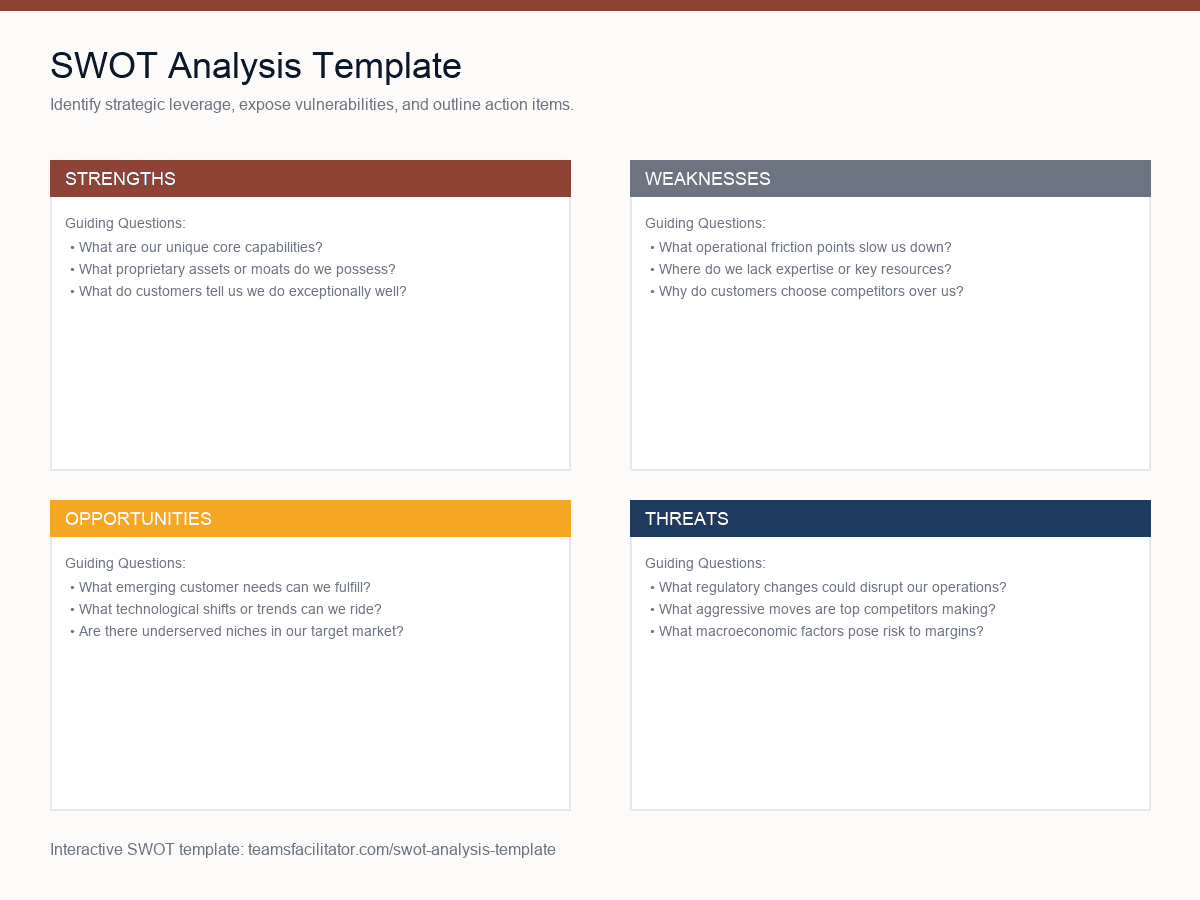
Ready to put this into practice? Run a guided session with your team using our interactive SWOT Analysis Template.
Quick Facts

SWOT Analysis Template
Assess strengths, weaknesses, opportunities, and threats to align strategy.

Personal SWOT Template
Conducting a SWOT analysis on yourself is an excellent way to map out professional goals and prepare for career moves. T...

Common SWOT Analysis Mistakes: The Danger of the Static List
The SWOT analysis is simultaneously the most famous and most frequently misused strategic framework in business. Its ele...