SWOT Analysis Examples: 6 Realistic Business Scenarios


On this page
- 1. The B2B SaaS Startup: The "Feature-Poor" Advantage
- 2. The Local Service Business: The Landscaping Asset
- 3. The Independent Restaurant: The "Small Dining Room" Paradox
- 4. The E-commerce Company: The "Rented Audience" Time Bomb
- 5. The Established Small Business: The Legacy Trap
- 6. The New Product Launch: The Hardware Pivot
- Summary: Digging Deeper
Download SWOT Analysis Templates
Download 100% free offline templates in your preferred format.
Most SWOT analyses fail because they are treated as a basic "check-the-box" exercise. A team sits in a room, lists broad, generic bullet points (e.g., "Good brand," "Weak budget," "Strong competitors"), and then files the document away, never to be seen again.
But the true power of a SWOT analysis lies in the nuanced intersections between your internal reality and external market dynamics. It should tell a story about where your business is vulnerable and exactly how you can leverage what you have to survive and thrive.
To demonstrate how to move beyond surface-level observations, here are 6 deeply realistic business scenarios. These stories highlight the difference between "boring, broad info" and the nuanced insights that actually drive strategy.
1. The B2B SaaS Startup: The "Feature-Poor" Advantage
The Company: Acme Metrics, a one-year-old analytics platform with a team of three developers, competing against giants like Google Analytics and Adobe.
The SWOT Trap: During their analysis, the founders list "We lack features" as their biggest Weakness and "Giant competitors with endless budgets" as their biggest Threat. Panic sets in. They decide they need to spend all their runway trying to build feature parity just to survive.
The Nuanced Insight: In a market completely overwhelmed by bloated, complex enterprise software, a limited feature set isn't a weakness—it is a profound Strength. The giants take six months and a dedicated data engineering team to onboard properly. Acme takes five minutes.
The real Threat isn't the competitor's massive feature list; it's the startup's own temptation to build features outside its core competency and lose its speed.
The Strategic Move: Acme realizes their churn is coming from enterprise clients who demand complex integrations, while their "super-fans" are small marketing agencies who just want clean, fast dashboards. They make a radical TOWS move: they actively delete 20% of their fringe features and double down on the single reporting metric small agencies care about. They reframe their marketing, aggressively positioning their "lack" of features as opinionated, streamlined efficiency. They stop fighting the giants and instead capture the massive, underserved market of non-technical founders.
2. The Local Service Business: The Landscaping Asset
The Company: Green Lawn Care, a 15-year-old family landscaping business struggling with tightening margins and seasonal unpredictability.
The SWOT Trap: The owner lists "Our equipment is getting old" as a Weakness and "Big national franchise moving into town" as a Threat. Their proposed strategy is to take out a dangerous loan to buy shiny new mowers to "compete on image."
The Nuanced Insight: The new mowers won't win a price war against a national franchise. The local business's true hidden Strength is 15 years of hyper-local soil, pest, and micro-climate knowledge. The big franchise brings generic, one-size-fits-all treatments and high employee turnover. Meanwhile, Green Lawn Care's biggest Weakness isn't old equipment; it's that their revenue drops to zero in the winter.
The Strategic Move: Instead of buying mowers, Green Lawn Care crosses their deep localized knowledge (Strength) with emerging smart-home tech (Opportunity). They pivot from a labor-heavy, commodity mowing business to a high-margin "Lawn Optimization" consultancy. They begin installing smart irrigation sensors for their wealthiest clients and charging a year-round monthly subscription to monitor and manage the systems remotely. They insulate themselves from the national franchise by offering a premium, tech-enabled service that requires deep local expertise, turning a seasonal hustle into recurring annual revenue.
3. The Independent Restaurant: The "Small Dining Room" Paradox
The Company: Bistro 42, an acclaimed but financially stressed independent Italian restaurant located in a bustling, expensive downtown district.
The SWOT Trap: "Our dining room only seats 30 people" goes into the Weakness column. "Move to a bigger location" goes into the Opportunities column. The chef spends months looking for investors to fund a massive, risky expansion.
The Nuanced Insight: Moving to a 100-seat location drastically increases fixed rent costs, requires a massive front-of-house staff, and—crucially—destroys the intimate, exclusive vibe that made Bistro 42 famous in the first place. The actual Weakness is unmonetized kitchen downtime during off-peak hours.
The Strategic Move: Bistro 42 decides to leverage the scarcity of their 30-seat room. They stop trying to turn tables quickly and instead raise prices, offering a slower, premium tasting menu. It becomes the hardest reservation in town (a massive Strength). Meanwhile, to generate volume, they use their large back-of-house kitchen to launch a delivery-only "ghost kitchen" brand selling high-end pizzas. They maximize their fixed costs (rent and kitchen staff) to capture the casual delivery market (Opportunity) without diluting the prestige of the core restaurant brand.
4. The E-commerce Company: The "Rented Audience" Time Bomb
The Company: Lumina Skincare, an explosive indie beauty brand that went from zero to $5M in revenue entirely on the back of viral TikTok videos.
The SWOT Trap: The marketing team proudly lists "1.5 million TikTok followers" as their greatest Strength. They list "Traditional retail distribution is hard" as a Weakness and decide to just keep pumping all their money into more TikTok content.
The Nuanced Insight: A massive audience built on an algorithm you do not control is not a pure strength; it is a massive, existential Threat. It is a rented audience. If the platform changes its rules tomorrow, engagement plummets, Customer Acquisition Cost (CAC) skyrockets, and the business dies overnight.
The Strategic Move: Lumina realizes they are sitting on a ticking time bomb. The strategy is to urgently convert that rented audience into an owned asset. They launch an interactive "Skin Type Quiz" on their website. To see the results, users must provide an email address and SMS opt-in. Lumina sacrifices some short-term sales conversion rate to build a massive, insulated, first-party database. When the algorithm inevitably shifts a year later, their competitors vanish, while Lumina thrives on the back of owned, free retention marketing.
5. The Established Small Business: The Legacy Trap
The Company: Smith & Associates, a highly respected, 30-year-old local accounting and bookkeeping firm.
The SWOT Trap: The partners list "Our 30-year reputation" as their core Strength. They list "AI and automated accounting software" as a massive Threat that will steal their clients. They decide to run local radio ads emphasizing their "human touch" to fight the software.
The Nuanced Insight: Their 30-year reputation is primarily with Baby Boomers who are actively retiring and closing businesses. To millennial entrepreneurs starting new ventures, a "30-year-old traditional firm" sounds slow, expensive, and outdated (a Weakness). Furthermore, AI isn't a threat to the firm—it's a threat to the low-margin, soul-crushing data entry work the partners actually hate doing.
The Strategic Move: Instead of fighting automation, Smith & Associates leans all the way in. They adopt the AI software (Opportunity) to automate 80% of the basic bookkeeping, drastically lowering their internal costs. They then use the time saved by their highly experienced CPAs to launch a premium "Fractional CFO" service. They rebrand their 30-year legacy not as "traditional accounting," but as "battle-tested strategic financial wisdom" combined with cutting-edge tech. They stop selling data entry and start selling business survival, doubling their margins.
6. The New Product Launch: The Hardware Pivot
The Company: FitTech, a successful software company with a highly engaged fitness app, deciding to launch their first physical wearable device.
The SWOT Trap: The product team lists "No hardware manufacturing experience" as a critical Weakness and "The Apple Watch" as a terrifying Threat. They spend millions trying to design a watch with a beautiful screen, custom OS, and a dozen sensors to compete on specs.
The Nuanced Insight: Trying to beat Apple or Garmin in a hardware spec war is financial suicide. FitTech's real Strength isn't hardware; it's their 5 years of highly engaged, niche behavioral data from their millions of app users. The hardware is just a delivery mechanism for the software.
The Strategic Move: FitTech scraps the expensive smart watch idea entirely. They design a minimalist, screen-less biometric band that does nothing but quietly feed heart rate and sleep data into their already-successful app. By reframing their lack of hardware expertise, they realize the physical device is just a loss-leader. The real product is the software subscription. They sell the simple hardware band at cost (making it irresistible compared to a $400 Apple Watch) solely to lock users into their $15/month premium app tier. They sidestep the Threat of Apple entirely by playing a completely different game.
Summary: Digging Deeper
A SWOT analysis is an engine for strategic moves, not a place to store vanity metrics or obvious complaints. When you conduct your next analysis, challenge every point. Ask yourself: Is this truly a strength, or is it a vulnerability disguised as a strength? Is this weakness actually an opportunity for a highly focused pivot?
By writing out the full story of your business dynamics, you turn a simple framework into a roadmap for survival and growth.
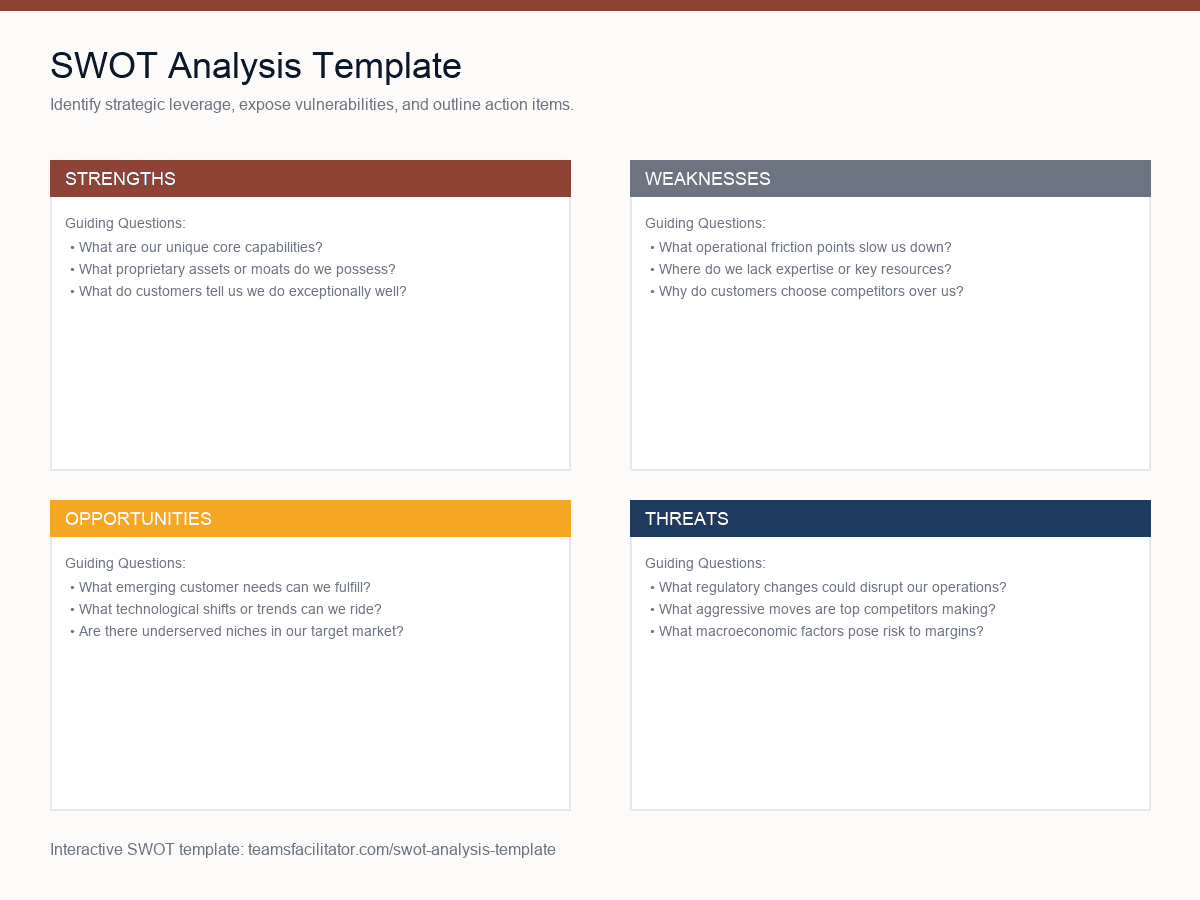
Ready to put this into practice? Run a guided session with your team using our interactive SWOT Analysis Template.
Quick Facts

SWOT Analysis Template
Assess strengths, weaknesses, opportunities, and threats to align strategy.

Personal SWOT Template
Conducting a SWOT analysis on yourself is an excellent way to map out professional goals and prepare for career moves. T...

Common SWOT Analysis Mistakes: The Danger of the Static List
The SWOT analysis is simultaneously the most famous and most frequently misused strategic framework in business. Its ele...