60 SWOT Analysis Questions That Produce Better Answers


Download SWOT Analysis Templates
Download 100% free offline templates in your preferred format.
If you start a SWOT analysis by asking, "What are our strengths?", you are going to get terrible answers. You will get generic, surface-level responses like "our brand," "our people," or "our product."
To get better answers, you have to ask better questions. The best strategic insights don't come from broad brainstorming; they come from highly specific, provocative questions that force a team to confront uncomfortable realities and hidden advantages.
Here are 60 specific SWOT analysis questions—15 for each quadrant—designed to cut through the noise and produce actionable strategic insights.
Strengths: Uncovering Your True Defensibility
Strengths are not just things you are "good at." A true strength is a defensible asset that your competitors cannot easily buy, copy, or steal.
- What is the number one reason our best customers refuse to leave us?
- If a competitor had 10x our budget, what is the one thing they still couldn't replicate?
- What internal process do we do faster or cheaper than anyone else in our industry?
- Which of our assets (data, community, IP, talent) is compounding in value over time?
- If we were forced to double our prices tomorrow, why would customers still buy from us?
- What do our competitors frequently complain about that we find completely effortless?
- Which team or department operates so efficiently that it feels like an unfair advantage?
- What exclusive relationships or partnerships do we hold that act as a barrier to entry for others?
- In what specific area is our brand trust highest, and how is that trust quantified?
- Where do we have a unique informational advantage over the rest of the market?
- What is the most profitable 20% of our business, and what drives that profitability?
- What technical debt have our competitors accumulated that we have successfully avoided?
- How does our company culture directly lower our operating costs (e.g., via high retention)?
- What is the absolute best feature of our product that we rarely talk about in our marketing?
- If our company was acquired tomorrow, what specific asset would the buyer be paying the most for?
Weaknesses: Confronting Internal Friction
Weaknesses are not just "things to improve." They are the internal frictions, dependencies, and bottlenecks that drag down your momentum and bleed your margins.
- If our business failed in the next 12 months, what internal bottleneck would be the most likely cause?
- Where are we most heavily dependent on a single employee or a small, siloed team?
- Which of our processes requires the most manual, unscalable human intervention?
- What do our lost prospects most frequently cite as the reason they chose a competitor?
- Where are we currently "renting" an asset that we should be owning?
- What metric is the executive team most afraid to look at right now?
- In what area of the business are we throwing money at a problem instead of fixing the root system?
- What specific customer complaint do we hear constantly but continue to ignore?
- Where is our tech stack or infrastructure slowing down our ability to deploy new features?
- Which of our products or services is a "loss leader" that isn't actually leading to cross-sells?
- Where is the friction highest for a new customer trying to onboard or make their first purchase?
- What decision takes a week to make in our company that takes a day at our competitors?
- Where is our profit margin the thinnest, and why haven't we abandoned that segment?
- What "best practice" in our industry are we currently terrible at executing?
- If a new CEO took over tomorrow, what is the first thing they would immediately cut?
Opportunities: Identifying External Leverage
Opportunities are not "things we could do." They are external shifts in the market, technology, or culture that you can leverage to create disproportionate growth.
- What new regulation or compliance law is about to create a massive headache for our competitors?
- What emerging technology could drastically reduce our cost of goods sold (COGS) if adopted early?
- Which customer segment is currently being completely over-served (and overcharged) by the market leaders?
- What related problem do our customers face right before or right after they use our product?
- Where is there a sudden influx of venture capital or government funding in our broader industry?
- What adjacent market relies on the exact same core competency we already possess?
- How is a shift in consumer behavior (e.g., remote work, privacy focus) playing perfectly into our hands?
- Which of our current, slow-moving competitors is most ripe for disruption or acquisition?
- What highly valuable data are we currently collecting but failing to monetize or use strategically?
- If we partnered with a non-competing brand that shares our audience, what joint offering could we create?
- What "premium" service could we unbundle and offer as a highly accessible, low-cost product?
- Where are talent layoffs in other sectors creating a unique opportunity for us to hire elite operators?
- What demographic shift will naturally increase the size of our total addressable market in the next 5 years?
- How could we shift our pricing model (e.g., from one-off to subscription) to capture more long-term value?
- What is a major frustration in our industry that everyone accepts as "just the way it is," which we could solve?
Threats: Recognizing Existential Risks
Threats are not just "new competitors." They are the macroeconomic, technological, and systemic risks that could render your entire business model obsolete.
- If a well-funded startup decided to destroy our business model, what exact strategy would they use?
- Which of our key suppliers or software vendors could cripple us if they doubled their prices tomorrow?
- What shift in a platform algorithm (e.g., Google, Apple, TikTok) could destroy our primary acquisition channel?
- How could artificial intelligence completely commoditize the core value we provide to our customers?
- What upcoming legal or regulatory change could make our current operations incredibly expensive or illegal?
- Which of our core customer segments is shrinking due to macroeconomic trends?
- If our biggest competitor decided to offer our core product for free as a loss-leader, how would we survive?
- What external factor (e.g., supply chain shortages, interest rates) do we rely on but have zero control over?
- What changing cultural norm or social stigma could suddenly make our brand look tone-deaf?
- Where are we most vulnerable to a cybersecurity breach, and what would the reputational cost be?
- What alternative solution—outside of our direct industry—are customers using to solve their problem?
- If the economy enters a deep recession, which of our product lines would be the first to be cut by clients?
- What key raw material or human skill is becoming increasingly scarce and expensive to acquire?
- Which massive tech giant (e.g., Amazon, Microsoft) is slowly creeping into our peripheral market?
- What is the "unthinkable" worst-case scenario that we are all too afraid to talk about in management meetings?
Next Steps: Moving from Questions to Strategy
Asking these 60 questions will expose the raw truth of your business. But insight without action is useless. Once you have documented the real answers, move immediately into a TOWS Matrix to combine these insights into actionable, defensive, and offensive strategic moves.
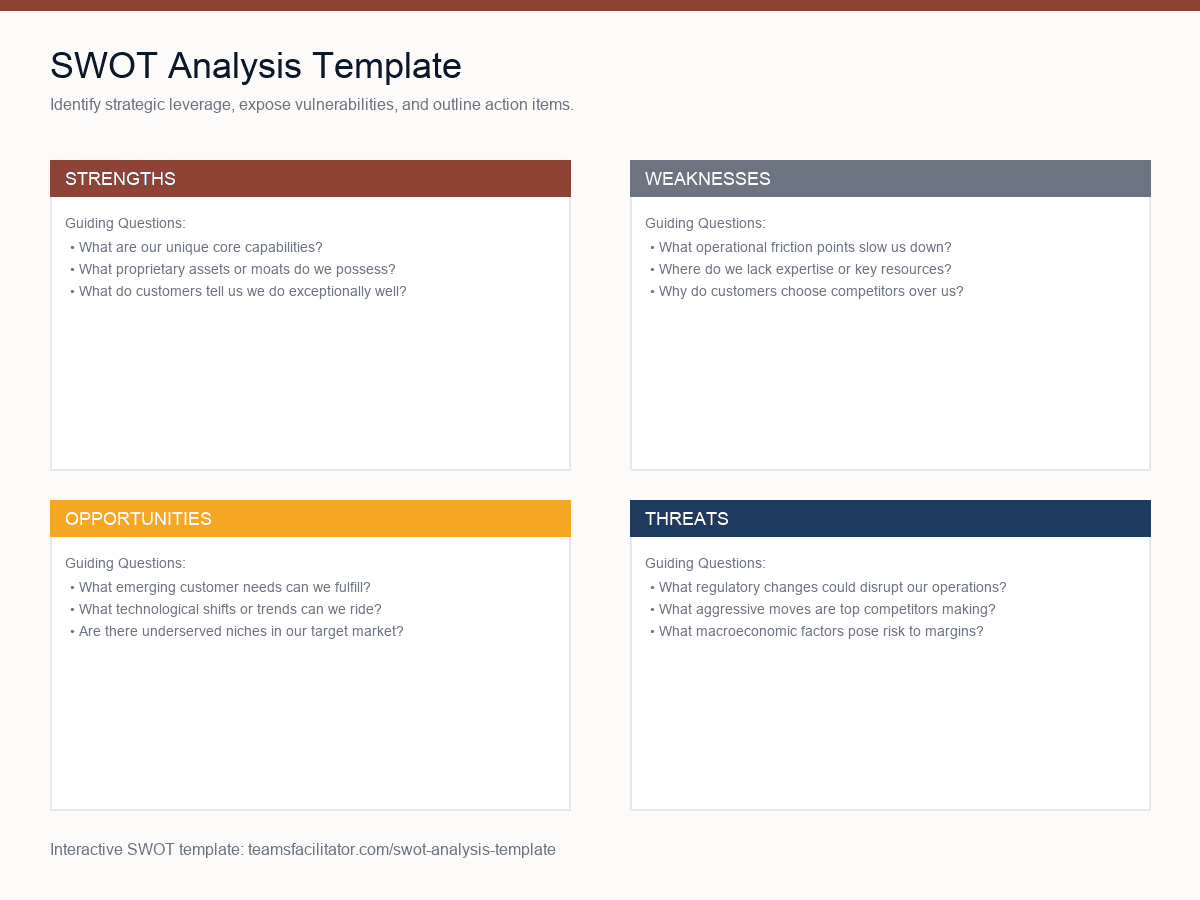
Ready to put this into practice? Run a guided session with your team using our interactive SWOT Analysis Template.
Quick Facts

SWOT Analysis Template
Assess strengths, weaknesses, opportunities, and threats to align strategy.

Personal SWOT Template
Conducting a SWOT analysis on yourself is an excellent way to map out professional goals and prepare for career moves. T...

Common SWOT Analysis Mistakes: The Danger of the Static List
The SWOT analysis is simultaneously the most famous and most frequently misused strategic framework in business. Its ele...