What to Do After a SWOT Analysis: Turn the Matrix Into Action


On this page
- Step 1: The "So What?" Filter (Pruning the List)
- Step 2: The TOWS Matrix (Generating Strategic Options)
- 1. Strengths to Opportunities (SO) - "Maxi-Maxi" Strategy
- 2. Strengths to Threats (ST) - "Maxi-Mini" Strategy
- 3. Weaknesses to Opportunities (WO) - "Mini-Maxi" Strategy
- 4. Weaknesses to Threats (WT) - "Mini-Mini" Strategy
- Step 3: Prioritization (Impact vs. Feasibility)
- Step 4: Assignment and OKR Integration
- Conclusion: SWOT is a Verb
Download SWOT Analysis Templates
Download 100% free offline templates in your preferred format.
Corporate hard drives are graveyards for SWOT analyses. Teams spend hours in a conference room, fill a whiteboard with Strengths, Weaknesses, Opportunities, and Threats, take a picture of it, and then... nothing happens.
A SWOT matrix is not a strategy. It is merely a snapshot of your current reality. If you stop after filling out the four boxes, you have wasted your time.
The real work begins after the SWOT analysis is complete. Here is a step-by-step playbook on how to turn your static matrix into an actionable strategic roadmap.
Step 1: The "So What?" Filter (Pruning the List)
Before you try to create a strategy, you must mercilessly prune your SWOT list. Most teams generate too many bullet points. You cannot execute on 20 different weaknesses and 15 opportunities.
Look at every single item on your board and ask: "So what?"
- Is it actionable? If a Threat is "Macroeconomic recession," there is nothing you can do about that directly. Change it to an actionable impact: "High risk of enterprise clients freezing software budgets."
- Is it lethal or explosive? Does this Weakness have the power to destroy the company? Does this Opportunity have the power to double our revenue? If the answer is no, delete it or move it to a "backlog" list.
Goal: Whittle your list down to the top 3-5 most critical items in each quadrant.
Step 2: The TOWS Matrix (Generating Strategic Options)
This is the most important step in the entire process. The TOWS matrix takes your internal factors (Strengths/Weaknesses) and crosses them with your external factors (Opportunities/Threats) to generate specific strategic moves.
Instead of looking at the boxes in isolation, you force them to interact. Draw a grid and brainstorm initiatives for these four intersections:
1. Strengths to Opportunities (SO) - "Maxi-Maxi" Strategy
Question: How can we use our biggest strengths to maximize and capture these external opportunities?
- Example: (Strength: Massive social media following) + (Opportunity: Rise of social commerce) = Strategy: Launch exclusive, limited-edition product drops directly inside the Instagram/TikTok checkout flows.
2. Strengths to Threats (ST) - "Maxi-Mini" Strategy
Question: How can we leverage our strengths to minimize or block these external threats?
- Example: (Strength: 10 years of proprietary user data) + (Threat: A well-funded new competitor entering the market) = Strategy: Launch a hyper-personalized recommendation engine that the new competitor cannot replicate because they lack the historical data.
3. Weaknesses to Opportunities (WO) - "Mini-Maxi" Strategy
Question: How can we take advantage of an opportunity to overcome or minimize our internal weaknesses?
- Example: (Weakness: Slow, legacy technology stack) + (Opportunity: AI integration becoming mainstream) = Strategy: Partner with a third-party AI vendor to build an intelligent front-end wrapper, hiding the legacy tech debt from the user while we slowly rebuild the back-end.
4. Weaknesses to Threats (WT) - "Mini-Mini" Strategy
Question: What defensive plan must we put in place to prevent our weaknesses from making us highly vulnerable to these threats?
- Example: (Weakness: High dependence on a single overseas supplier) + (Threat: Looming global supply chain disruptions) = Strategy: Immediately secure secondary, localized manufacturing contracts, even at a lower margin, to ensure business continuity.
Step 3: Prioritization (Impact vs. Feasibility)
By completing the TOWS matrix, you should now have a list of 10 to 15 specific strategic initiatives. You cannot do all of them.
Plot your new strategic initiatives on a simple 2x2 matrix: Impact vs. Feasibility (or Effort).
- High Impact, Low Effort (Quick Wins): Do these immediately. They build momentum.
- High Impact, High Effort (Major Projects): Pick only 1 or 2 of these. These are your core strategic focus areas for the year.
- Low Impact, Low Effort (Fill-ins): Delegate these or save them for when you have excess capacity.
- Low Impact, High Effort (Time Wasters): Delete these entirely.
Step 4: Assignment and OKR Integration
A strategy without an owner is just a wish. For the initiatives you selected in Step 3, you must immediately assign accountability.
If your company uses OKRs (Objectives and Key Results), this is where the SWOT matrix becomes operationalized.
- The Initiative becomes the Objective. (e.g., Objective: Diversify our supply chain to mitigate geopolitical risk.)
- You define the Key Results. (e.g., KR1: Onboard 2 new domestic suppliers. KR2: Shift 30% of Q4 production volume to domestic partners.)
- You assign a single DRI (Directly Responsible Individual).
Conclusion: SWOT is a Verb
The most successful companies do not treat SWOT as a noun (a document you create). They treat it as a verb (a process of continuous realignment).
By forcing your analysis through the "So What?" filter, cross-referencing it in a TOWS matrix, prioritizing the output, and assigning direct ownership, you transform a theoretical brainstorming session into a ruthless engine for execution.
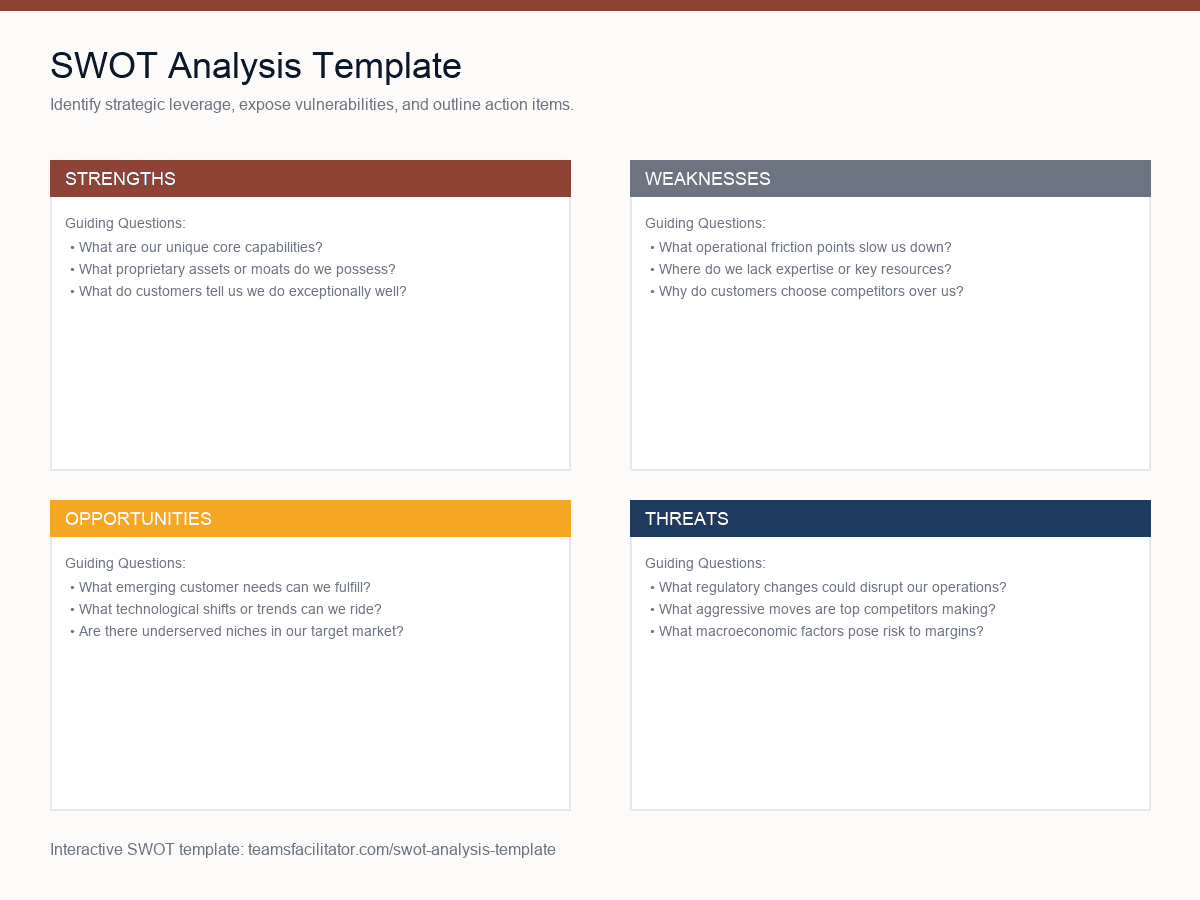
Ready to put this into practice? Run a guided session with your team using our interactive SWOT Analysis Template.
Quick Facts

SWOT Analysis Template
Assess strengths, weaknesses, opportunities, and threats to align strategy.

Personal SWOT Template
Conducting a SWOT analysis on yourself is an excellent way to map out professional goals and prepare for career moves. T...

Common SWOT Analysis Mistakes: The Danger of the Static List
The SWOT analysis is simultaneously the most famous and most frequently misused strategic framework in business. Its ele...