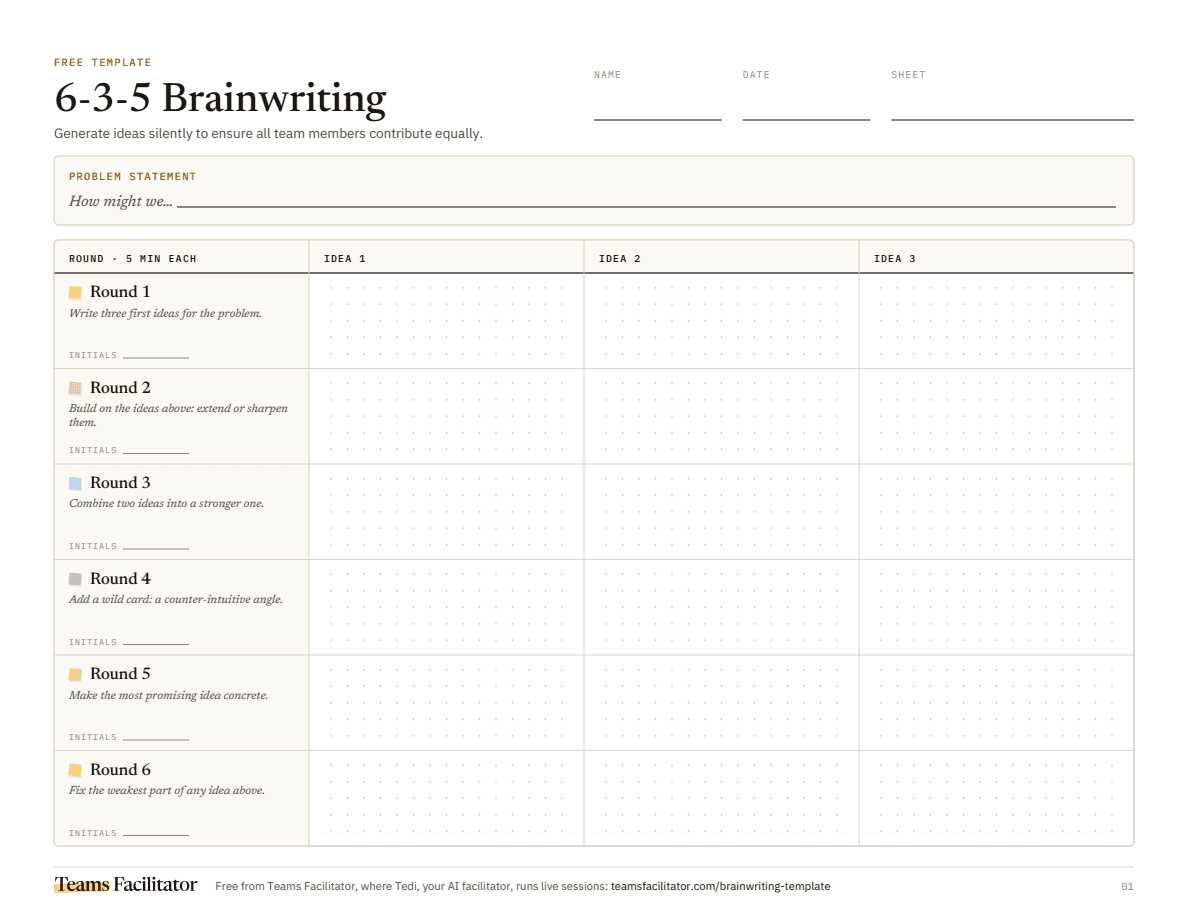
What is 6-3-5 brainwriting?
6-3-5 Brainwriting is a silent way to brainstorm. The name is the recipe: 6 people each write 3 ideas in 5 minutes, then pass their sheet on, and the next person builds on what's there. After six rounds the group has up to 108 ideas in about 30 minutes. Bernd Rohrbach created it in 1968 to fix what goes wrong when people brainstorm out loud: one person talks at a time, the loudest voices set the direction and quieter people hold back.
- Best for
- Teams who need a lot of ideas fast, without the loudest voice taking over
- Time
- 30–45 mins
- Who joins
- 3 to 12 people (6 is the classic)
- You leave with
- Up to 108 ideas sorted into themes, and 1–3 picked to pursue with owners.
When to use 6-3-5 brainwriting
Use it when you need a lot of ideas fast, when the same few people always do the talking, when the group keeps circling the first idea someone said out loud, or when seniority in the room makes people hold back. It works for products, marketing, processes, events and team problems alike.
How to run 6-3-5 brainwriting
Agree one challenge question first, usually starting with “How might we…?”, and put it where everyone can see it. Give each person a sheet with three columns. Each round, everyone writes three ideas in silence, building on the ideas already on the sheet or starting fresh, then passes the sheet on. Run one round per person, between three and six; five minutes a round is the classic. When the rounds end, sort every idea into themes and give everyone three or five dots to vote with in secret. Discuss the top ideas and pick one to three to pursue, each with an owner and a date.
Questions to ask in each section
01Challenge
- What do we need ideas for, in one question?
- Is it narrow enough to focus the ideas and open enough to have many answers?
02Ideas
- Which three ideas would you add that aren't on the sheet yet?
- Which idea on the sheet could you build on, combine or turn around?
- Which themes do the ideas fall into?
03Top Ideas
- Where would you put your dots if nobody could see your vote?
- What makes each top idea worth trying?
04Next Steps
- Which one to three ideas will we pursue?
- Who owns each one, and what's the first step, by when?
Worked examples
Getting trial users to activate
A six-person SaaS team looking for ways to get more trial users to their first report.
- How might we get more trial users to their first report in week one?
- A sample report ready on day one
- A 3-step checklist inside the app
- Import a spreadsheet in one click
- A 15-minute setup call for bigger accounts
- A founder email on day two
- Email the moment the first data arrives
- Templates for the five most common reports
- A sample report ready on day one (5 dots)
- Import a spreadsheet in one click (4 dots)
- A 3-step checklist inside the app (3 dots)
- Ana prototypes the sample report by Friday
- Ben scopes the spreadsheet import by the 14th
Common mistakes
- Starting the rounds before the challenge is clear, so every sheet answers a different question.
- Talking during the rounds, which brings back the loudest-voice problem the method is there to fix.
- Judging ideas while you write them. The rounds are for volume; choosing comes later.
- Ignoring what's already on the sheet instead of building on it.
- Showing the votes as they come in, so everyone piles onto the early favorite.
- Ending with a wall of ideas and nobody owning the next step.
Let Tedi run your 6-3-5 brainwriting session
On paper, someone has to keep time, pass the sheets, type up 108 ideas and count the votes. In the session everyone writes on their own digital sheet, and the sheets move on by themselves when each round ends. Tedi sorts every idea into themes on the shared board, the dot vote stays secret until the host reveals it, and Tedi leads the discussion until the team has picked its ideas, with owners and dates.
- One shared canvasEveryone adds notes at the same time, in the room or remote.
- A facilitator in the roomTedi keeps each section moving and draws in the quiet voices.
- A written outcomeDecisions, owners and next steps, captured before anyone leaves.
6-3-5 brainwriting FAQ
What is the 6-3-5 method?
A silent brainstorming technique. 6 people each write 3 ideas in 5 minutes, then pass their sheet on and build on what's already there. After six rounds the group has up to 108 ideas. Bernd Rohrbach created it in 1968.
What's the difference between brainwriting and brainstorming?
In brainstorming people say their ideas out loud, one at a time, so the first and loudest ideas shape the rest. In brainwriting everyone writes at the same time and in silence, so you get more ideas and the quiet people are heard as much as anyone.
Do we need exactly six people?
No. The session works with 3 to 12 people, with one round per person, between three and six. Six people get the classic 108 ideas. In a small group, Tedi can take a seat and write a sheet too.
How long does it take?
About 30 to 45 minutes: a few minutes to agree the challenge, the silent rounds (3, 5 or 7 minutes each, the host picks), then the themes, the vote and the discussion.
Are the ideas anonymous?
Yes. The sheets don't show who wrote what, and the dot vote stays secret until the host reveals it, so each idea is judged on what it says.
Can we run it alongside Microsoft Teams or Zoom?
Yes. Teams Facilitator has video built in, but you can keep your call in Microsoft Teams, Zoom or Google Meet and run the session in a browser tab alongside it. Everyone writes on their own laptop, and guests join with just their name.
What happens after the vote?
Tedi leads the discussion of the top ideas and the team picks one to three to pursue, each with an owner and a date in Next Steps. You get the summary afterwards, like every session.