SWOT vs. TOWS: What's the Difference?


Download SWOT Analysis Templates
Download 100% free offline templates in your preferred format.
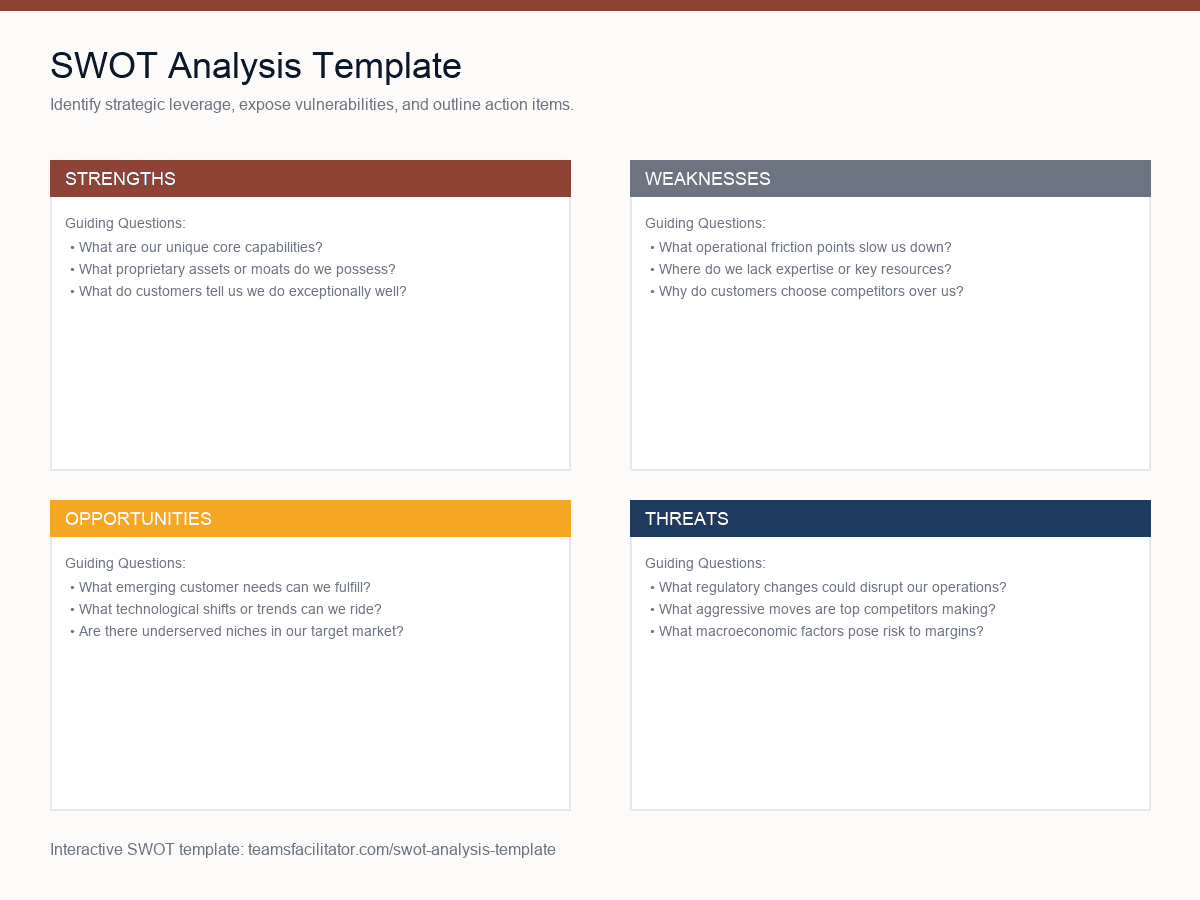
SWOT and TOWS contain the exact same four letters. They deal with the exact same four concepts: Strengths, Weaknesses, Opportunities, and Threats.
Because of this, people often use the terms interchangeably, assuming they are just two different acronyms for the exact same exercise. But in the world of strategic planning, SWOT and TOWS serve two completely different functions.
If you want to build a strategy that actually gets executed, you need to understand the difference between the two—and why you absolutely must use both.
SWOT Analysis: The "What" (The Audit)
A SWOT analysis is an audit. It is a snapshot of your current reality.
When you conduct a SWOT analysis, your goal is simply identification. You are trying to figure out what exists inside and outside of your company.
- Internal Focus: What are we currently good at? (Strengths). What are we currently bad at? (Weaknesses).
- External Focus: What is happening in the market that could help us? (Opportunities). What is happening that could hurt us? (Threats).
The Output of SWOT: A list. When you finish a SWOT analysis, you have four lists of bullet points. A list is incredibly useful for situational awareness, but a list is not a strategy. You know you have a "weak supply chain," but SWOT doesn't tell you what to do about it.
TOWS Matrix: The "How" (The Action Engine)
If SWOT is the audit, TOWS is the action engine.
While SWOT isolates the four categories into neat, separate boxes, a TOWS matrix forces them to collide. It takes the bullet points you generated in your SWOT analysis and crosses them against each other to generate specific strategic moves.
The Output of TOWS: Actionable initiatives. When you finish a TOWS matrix, you don't have lists; you have verbs.
- SO Strategy (Offensive): How do we use our Strengths to capture an Opportunity?
- ST Strategy (Defensive): How do we use our Strengths to block a Threat?
- WO Strategy (Improvement): How do we use an Opportunity to fix a Weakness?
- WT Strategy (Survival): How do we minimize our Weaknesses to survive a Threat?
The Key Differences at a Glance
| Feature | SWOT Analysis | TOWS Matrix |
|---|---|---|
| Primary Purpose | Identification and Auditing | Action Planning and Strategy Generation |
| The Output | Static lists of bullet points | Dynamic, actionable strategic initiatives |
| The Question It Answers | "Where are we right now?" | "What are we going to do next?" |
| Mindset Required | Analytical, observational, honest | Creative, problem-solving, decisive |
| When to Use It | At the very beginning of a planning cycle | Immediately after the SWOT is complete |
The Verdict: You Need Both
Asking "Which is better: SWOT or TOWS?" is like asking, "Which is better: diagnosing the disease or prescribing the medicine?"
They are not competing frameworks; they are sequential steps in a single, unified strategic process.
Step 1: Run a rigorous SWOT Analysis to gather the raw data. Be ruthlessly honest about your weaknesses and hyper-specific about market threats. Step 2: Immediately push that raw data into a TOWS Matrix to generate the actual strategic playbook your company will execute over the next year.
If you only do SWOT, you have wasted your time complaining and bragging. If you try to jump straight to TOWS without an honest SWOT audit first, you will build a strategy based on assumptions rather than reality. Use both, in order, to turn observations into action.
Ready to put this into practice? Run a guided session with your team using our interactive SWOT Analysis Template.
Quick Facts

SWOT Analysis Template
Assess strengths, weaknesses, opportunities, and threats to align strategy.

Personal SWOT Template
Conducting a SWOT analysis on yourself is an excellent way to map out professional goals and prepare for career moves. T...

Common SWOT Analysis Mistakes: The Danger of the Static List
The SWOT analysis is simultaneously the most famous and most frequently misused strategic framework in business. Its ele...