The TOWS Matrix: How to Turn Your SWOT Analysis Into a Strategy


Download SWOT Analysis Templates
Download 100% free offline templates in your preferred format.
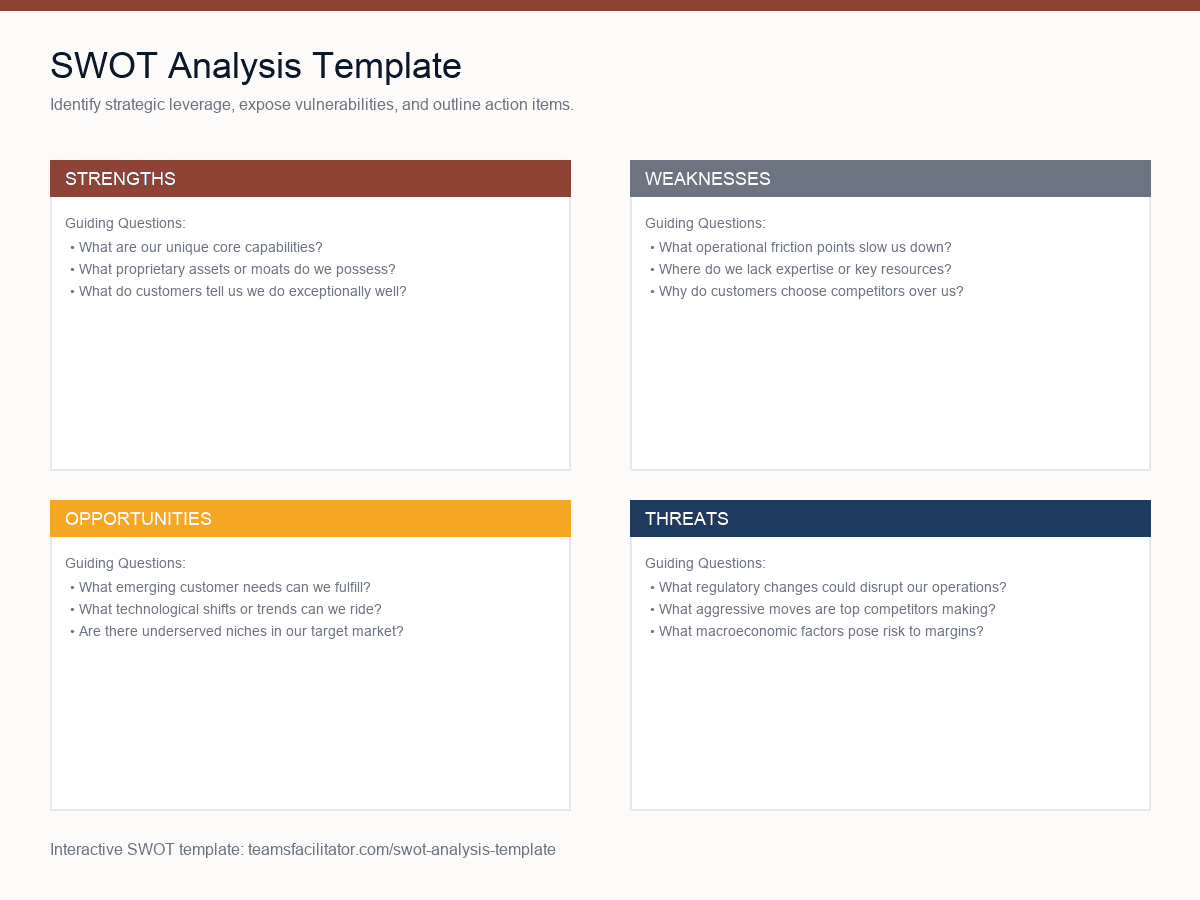
A SWOT analysis has a fatal flaw: it is completely static.
When you finish a SWOT session, you are left with four lists (Strengths, Weaknesses, Opportunities, Threats). But lists are not strategies. You know that you have a "strong brand" and a "weak supply chain," but the framework itself doesn't tell you what to do about it.
Enter the TOWS Matrix.
Developed by management consultant Heinz Weihrich, the TOWS matrix takes the static observations of a SWOT analysis and forces them to interact. By cross-referencing your internal realities with your external environment, TOWS generates specific, actionable strategic moves.
Here is how to use the four quadrants of the TOWS Matrix to build your strategic roadmap.
The 4 Quadrants of the TOWS Matrix
To build a TOWS matrix, draw a grid. Place your Strengths and Weaknesses on one axis (Internal Factors) and your Opportunities and Threats on the other axis (External Factors).
Where they intersect, you will brainstorm specific strategic initiatives.
1. Strengths + Opportunities (SO): The "Maxi-Maxi" Strategy
The Goal: Use your internal strengths to maximize and capture external opportunities. This is your pure offensive strategy.
- The Question: "How can we use our biggest strengths to aggressively capture this new opportunity?"
- Real-World Example: An indie cosmetics brand has a massive, highly engaged TikTok following (Strength). The market is seeing a massive surge in "social commerce" where users buy directly inside the app (Opportunity).
- The SO Strategy: Launch exclusive, limited-edition product drops natively within the TikTok checkout flow, bypassing traditional retail entirely.
2. Strengths + Threats (ST): The "Maxi-Mini" Strategy
The Goal: Use your internal strengths to minimize, block, or completely bypass external threats.
- The Question: "How can we leverage our unique advantages to protect ourselves from this looming threat?"
- Real-World Example: A software company has 10 years of deeply ingrained, proprietary user behavior data (Strength). A well-funded startup just entered the market with a slicker, cheaper app (Threat).
- The ST Strategy: Use the proprietary historical data to build a hyper-personalized AI recommendation engine. The new competitor, despite having a slick app, suffers from the "cold start problem" and cannot match the personalization, neutralizing their threat.
3. Weaknesses + Opportunities (WO): The "Mini-Maxi" Strategy
The Goal: Overcome or minimize an internal weakness by taking advantage of an external opportunity.
- The Question: "How can we use this market opportunity to fix or bypass our biggest internal bottleneck?"
- Real-World Example: A traditional bank has a slow, legacy technology stack that takes months to update (Weakness). There is a massive rise in consumer demand for seamless, instant mobile payments (Opportunity).
- The WO Strategy: Instead of trying to rebuild their legacy code over 5 years, the bank acquires or partners with a nimble FinTech startup (using the market opportunity) to build a fast front-end wrapper, delivering the mobile experience instantly while masking the internal tech debt.
4. Weaknesses + Threats (WT): The "Mini-Mini" Strategy
The Goal: Minimize your weaknesses and avoid threats. This is your pure defensive or survival strategy.
- The Question: "What defensive plan must we put in place right now to prevent our weaknesses from making us a victim of this threat?"
- Real-World Example: A hardware manufacturer relies entirely on one factory in Southeast Asia (Weakness). Geopolitical tensions and supply chain disruptions are rising globally (Threat).
- The WT Strategy: Immediately secure secondary, localized manufacturing contracts in Mexico or the US. Even if it results in a lower profit margin, this defensive move ensures business continuity if the primary factory goes offline.
From Matrix to Action
A completed TOWS matrix will give you a list of 10 to 15 specific strategic initiatives across the four quadrants.
You cannot execute all of them at once. To turn this matrix into action:
- Plot the initiatives on an Impact vs. Effort matrix.
- Select the top 2-3 high-impact initiatives (usually a mix of SO offensive moves and WT defensive moves).
- Assign a Directly Responsible Individual (DRI) to each initiative.
- Convert the initiatives into OKRs (Objectives and Key Results) to track progress.
A SWOT analysis tells you where you are. The TOWS matrix tells you where to go next.
Ready to put this into practice? Run a guided session with your team using our interactive SWOT Analysis Template.
Quick Facts

SWOT Analysis Template
Assess strengths, weaknesses, opportunities, and threats to align strategy.

Personal SWOT Template
Conducting a SWOT analysis on yourself is an excellent way to map out professional goals and prepare for career moves. T...

Common SWOT Analysis Mistakes: The Danger of the Static List
The SWOT analysis is simultaneously the most famous and most frequently misused strategic framework in business. Its ele...